
Research
Timbre Perception, Representation, and its Neuroscientific Exploration: A Comprehensive Review
Description
A multidisciplinary syhthesis exploring how the human brain decodes and represents the "color" of sound. The review traces the evolution of timbre studies from its etymological roots and 19th-century foundations (Helmholtz) to contemporary computational representations and neuroscientific frameworks.
Highlight
This review examines how timbre perception emerges from spectral-temporal features independent of pitch or loudness, while surveying evidence from perceptual scaling, high-dimensinal representations, and neuroscientific studies (fMRI/EEG) to demonstrate distriputed auditory and affective processing.
https://arxiv.org/html/2405.13661v1
By exploring the classic acoustic frameworks and modern computational models, the work clarifies why timbre remains elusive and motivates a shift in focus toward rhythm as a more quantifiable perceptual driver.
Technical Projects
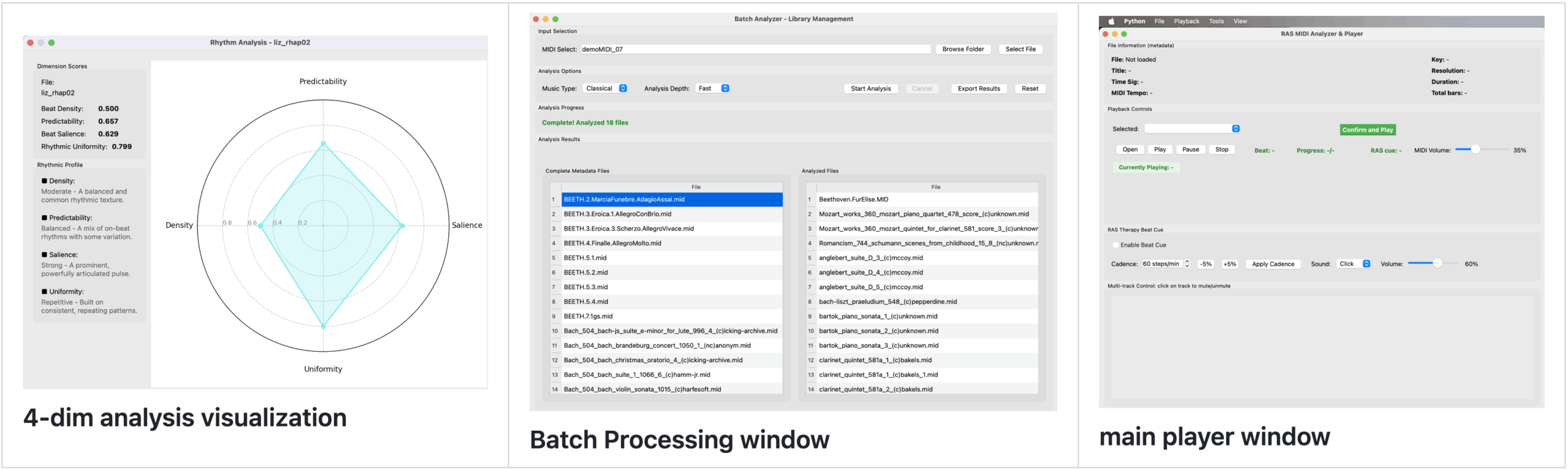
MIDI Player/Analyzer for RAS
Bridging music technology, perceptual rhythm analysis, and clinical rehabilitation: a system for rhythm quantification and therapeutic music selection.
Description
A clinically grounded rhythm quantification and music selection system for gait rehabilitation, integrating interpretable rhythmic features with robust beat structure analysis.
Highlight
-
Clinical relevance: Designed to support Rhythmic Auditory Stimulation (RAS) gait therapy by identifying rhythm features that correlate with motor entrainment and therapeutic benefit, addressing a key gap in neurologic music therapy research.
-
4D rhythmic quantification: Extracts interpretable rhythmic metrics—beat density, predictability, beat salience, and rhythmic uniformity—that map directly to clinically meaningful indicators rather than pure statistical features.
-
Efficient dual-layer analysis: Combines fast MIDI-based screening with neural network-refined audio tracking (RNN) for robust meter & pulse structure recognition suitable for both large-scale filtering and precise therapeutic selection.
-
Precision timing & adaptability: Provides microsecond-accurate playback and synchronization with adjustable cadence, enabling reliable music-gait alignment for rehabilitation contexts.
Project repo: https://github.com/tellmeayu/MIDI_Player-Analyzer_for_RAS.git
Real-time Beat Tracking and Generative 3D Visualization System
Description
A real-time audiovisual system developed in Max/MSP that explores how rhythmic structures extracted from audio can be translated into dynamic, spatial visual behaviors.
Highlight
-
Rhythm-driven visual agency: Uses beat and event-level rhythmic features as continuous control parameters, allowing rhythm to actively shape form, motion, and emergence in a generative 3D environment.
-
Controlled stochasticity: Combines deterministic logical operations with bounded randomness, ensuring structural coherence while preserving perceptual variability and expressivity.
-
Multi-band rhythmic mapping: Separates low- and high-frequency rhythmic events and maps them to distinct visual behaviors, revealing layered rhythmic structures through spatial differentiation.
-
Algorithmic form contrast: Juxtaposes rigid geometric wireframes with deformable NURBS surfaces to explore tension between order and fluidity in algorithmically mediated systems.
Demo video
Project repo: https://github.com/tellmeayu/Real-time-Beat-Tracking-and-Generative-3D-Visualization-System.git
Musical Performance
Music Performance Showreel: Accordion & Piano
A curated selection of five short pieces:
Saber Dance; Danube Waves;
Clementi Sonatina in F Major; Mozart Sonata in C Major; Bach Minuet in D Minor.